
Content Needs for AI Licensing
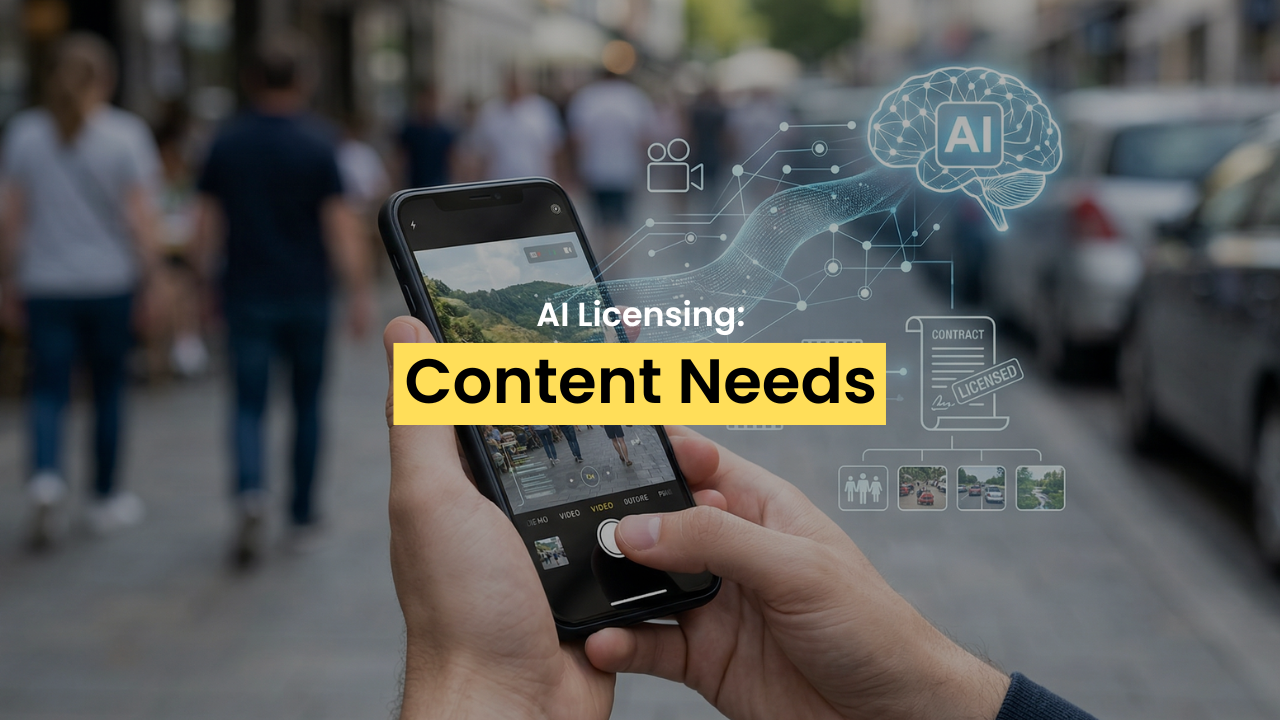
Welcome to our AI Licensing program! We’re so glad to have you on board. To help you get started, we’ve put together a guide on the specific types of content our partners are currently looking for. If your library doesn't perfectly match these categories, don't sweat it, many of our clients are simply looking for high-quality, 'real-world video' of all kinds. This list is just a snapshot of the variety we're seeing in current requests to give you a head start!
Video + Audio: Urban Scenes With People, Vehicles, and Storefronts
We’re after everyday city moments with natural activity happening in the frame, things like someone crossing a busy intersection, getting in or out of a car, or buying something at a night market.
Great examples include:
Busy street intersections
Outdoor cafés in a city plaza
Subway platforms during rush hour
Rooftop views at sunset
Night markets or street‑food scenes
Group yoga in the park
High‑rise balcony views
Graffiti alleys
City parks surrounded by skyscrapers
Financial districts in the morning
Rainy urban scenes
Video + Audio: Human‑Centric Footage
Human‑to‑human moments
Think natural, everyday interactions, cuddling, chatting, greeting, or playful moments.
Example: A dad picking up toddlers from daycare.Human interaction with objects
Simple actions like holding, carrying, opening doors, moving around obstacles, or using everyday items.
Examples: Preparing food, using utensils, handling objects around the home.Movement & physical activity
Dynamic body movement is especially valuable, anything from sports to expressive motion.
Examples: Breakdancing, gymnastics, team sports, ballroom dancing, group yoga.Eating & drinking
People enjoying food or beverages in everyday settings (just avoid branded items).Big crowds
Lively group activities with lots of people in motion.
Example: Dance fitness classes.DIY & product interactions
Hands‑on moments like fixing something, crafting, or reviewing products on camera
Video + Audio: High‑Production Ambient & Environmental Scenes
For this category, we’re looking for beautifully captured ambient moments, clips where the natural sound or SFX carries the scene rather than dialogue. Think simple, everyday environments with clean, high‑quality audio.
Great examples of what works well:
Hands typing on a keyboard
ASMR‑style chopping vegetables
A busy restaurant with natural ambience
Shoes walking on gravel or a forest path
Walking through a city with street sounds
Docks and waterfront ambience
Urban street corners with passing cars and people
Forest walks with natural footsteps and birds
People playing instruments (no talking)
A ball bouncing against a wall
🚗 Dashcam Realism
Specs: High-resolution dashcam only (no mobile phones).
The Big Need: Near-misses and road incidents.
The Detail: We need the "lead-up." Include at least 2–3 seconds before the incident, with a total clip length of 10+ seconds.
Gold Standard: Check out this clip for the perfect example.
💥CCTV & High-Stakes Action
This section outlines the specific types of surveillance and security footage required by our AI-licensing partners. We accept high-resolution CCTV, Bodycam, Mobile, and Drone footage.
To maximize the value of your submissions, ensure clips are high-resolution (1080p+ preferred), stable with minimal camera shake, and capture the natural lead-up and full context of the scene.
🟢 1. "Normal" Everyday Activities & Crowd Dynamics
AI models require baseline footage of routine human behavior to learn how to distinguish regular activities from anomalies.
Baseline Movements: People walking through hallways, running, or carrying bags, packages, and everyday objects.
Access Control: Individuals entering/exiting doors normally. Using badge readers or card scanners properly to get access inside or through barriers etc
Crowd Flow & Dynamics: People standing in lines, queuing, encountering bottlenecks, or moving naturally in high-traffic environments.
🟡 2. Anomalies, Loitering & Suspicious Behavior (Pre-Incident)
This category focuses on the behavioral indicators that precede security events. Footage should capture these actions clearly, showing the duration of the behavior.
Tailgating & Piggybacking: One person badges into a restricted area and another person follows behind without scanning their own credentials.
Seeking variations: Close-following, a distracted authorized user failing to notice, an intentional hold-open vs. an accidental slip-through.
Casing & Suspicious Observation: Individuals lingering near building entrances, repeatedly checking handles on locked doors or windows, or intentionally filming/staring directly at security cameras.
Loitering & Pacing: Individuals standing still for extended periods in restricted or unusual zones, pacing back and forth, or walking continuous loops around a facility's perimeter.
Left & Unattended Objects: A person intentionally placing down or dropping a bag or object and walking (or running) away, leaving it unattended.
🔴 3. High-Stakes Security Events & Action
We are seeking high-production or real-world captures of active security breaches, accidents, and environmental hazards.
Forced Entry & Tampering: Active attempts to break into a building, physical pulling/forcing of locked doors and windows, or physical tampering with card readers and security infrastructure.
Brandishing & Threat Detection: A person holding an object in a way that suggests a threat (such as a weapon or weapon-like object). Note: Focus on the stance and handling; do not submit graphic violence or bloodshed.
Violence & Crime: Riots, looting, active street fights, brawls, house break-ins, and burglaries.
Accidents & Crises: Building collapses, slips, trips, falls, vehicle crashes, and sudden emergency evacuations or crowd surges/panic.
Fire, Smoke & Natural Hazards: Industrial fires, residential fires, wildfires, active flooding, severe storm damage, and earthquake impacts.
🧤 The "First-Person" Perspective
We are looking for "POV" footage that captures the world exactly as a worker sees it.
Perspective: Egocentric (first-person) via head-mounted camera.
Framing: The viewer must see what the worker sees. Hands must be clearly in-frame at all times, visible from just above the elbow through to the fingertips.
Format: Landscape orientation. Footage must be stable, well-lit, and high-resolution.
Duration: Each task segment must be a minimum of 1.5 minutes of continuous, uninterrupted footage.
Environment: Authentic, real-world work settings only. No staged environments, studios, or "office-based" tasks (no keyboards/screens).
What We’re Looking For
Below is a breakdown of the types of workplaces and tasks that are most valuable. This is only a sample — the full catalog includes ~1,000 everyday tasks across service, trades, manufacturing, agriculture, and more.
These recordings are typically 1–5 minutes, filmed at a natural pace, with both hands visible.
1. Food, Service & Retail Work
Real workplaces with real activity — not staged kitchens or empty shops.
Examples include:
Weighing, mixing, and preparing ingredients
Setting tables, polishing cutlery, arranging glassware
Mixing drinks behind a bar
Grooming pets (washing, brushing, trimming)
Stacking shelves, displaying goods, packing items
Fuel station tasks: filling tanks, checking oil or tyre pressure
Cleaning, peeling, slicing food using manual or electric tools
These everyday service tasks are extremely valuable for robotics training.
2. Trades, Repairs & Workshop Tasks
Hands‑on, tool‑based work is especially important.
Examples include:
Bricklaying and stonework
Carpentry and joinery at a workbench
Plumbing: cutting, threading, bending, assembling pipes
Painting walls, fixtures, or decorative objects
Welding and metal cutting
Mechanical repairs on cars, engines, or machinery
Electrical fitting, wiring, and component repair
Tailoring, sewing, embroidery, garment repair
Shoemaking and leatherwork
Jewellery making, soldering, shaping metal
Grinding and polishing optical lenses
These tasks help AI understand fine motor skills, tool use, and multi‑step processes.
3. Agriculture, Gardening & Outdoor Work
Natural, varied environments are highly valuable.
Examples include:
Inspecting, grading, packaging crops
Pruning trees, trimming hedges, mowing lawns
Milking livestock
Picking fruit, vegetables, nuts, or other crops
Outdoor variation (weather, terrain, lighting) is a major plus.
4. Manufacturing, Warehousing & Machine Operation
Robotics models rely heavily on understanding industrial workflows.
Examples include:
Operating food production machinery
Assembling mechanical parts
Driving vans, taxis, or small trucks
Loading/unloading heavy goods
Clearing machine blockages
Cleaning equipment and tools
Packing furniture, appliances, or goods for transport
These environments offer rich, real‑world complexity.
5. Domestic & Elementary Work Tasks
Simple, everyday tasks are just as important.
Examples include:
Sweeping, vacuuming, polishing, washing floors
Making beds, cleaning bathrooms
Hand‑laundering and pressing clothes
Washing, peeling, chopping, mixing ingredients
Shoe cleaning and polishing
Delivering packages or goods
These tasks help AI understand the basics of human movement and interaction with objects.
POV Brief : What Makes a Great Submission?
To maximise your chances of selection:
✔ Real workplaces, not staged setups
Busy, imperfect, lived‑in environments are ideal.
✔ Multiple different tasks
Not the same action repeated — variety is essential.
✔ Natural pace, natural workflow
Just do the job as you normally would.
✔ Both hands visible
Robotics models need to see how humans use tools and objects.
✔ 1–5 minute clips
Short, focused tasks work best.
✔ Diversity across everything
Different people, locations, lighting, tools, layouts, and industries.
Other Desirable Content Themes
Vlogging content and a bonus if there is ‘Face to camera’ talking.
Wildlife footage
Podcasts & street interviews
Micro Dramas
Animation
DIY, Crafts & Restoration content
Drone footage
Natural landscapes (nature)
Underwater footage in various settings i.e rivers, lakes, oceans
If you need to refresh yourself about this program click the button below to get started!